News and Updates
STORIES OF CHANGE
What’s blossoming
LATEST IN OUR CARE REVOLUTION
We believe that community-led systems change grows in the daily acts of interpersonal care and shared visions of flourishing futures. Here, we share the latest from our work, our partners, and the communities we are co-creating with.
August 2026 | POP Praxis’ Year in Review 2025-26 and Call for Projects
View POP Praxis’ Year In Review 2025-26 by Divija Madhani.
In March 2025, I wrapped up a federally-funded climate misinformation project with UBC Centre for the Study of Democratic Institutions (CSDI). During the project, I was able to situate the importance of trust and relationship-building within communities—especially citizens and institutions of authority, such as government, healthcare professionals, and journalism outlets—to maintain effective communication and create responsive policies that the public is willing to care about.
I was able to carry forward that insight into my programs impact evaluation work with CityHive Vancouver. Once again, I approached this from a relational perspective—considering what kinds of stories matter and reflect the impact that programs create in their communities by working on multi-stage evaluations for CityHive’s various incredible programs related to civic literacy and engagement.
At this time, I also expanded my approach to knowledge-building with the public by delivering a series of climate justice webinars with the South Vancouver Seniors Network at the Marpole Oakridge Family Place. I had a wonderful time discussing topics such as the polycrisis, the role of community in building resilient solutions, and engaging in dialogue and emotionally compelling questions about what it means to take care of each other during events that create vulnerable populations—such as seniors—due to infrastructure that doesn’t support them, and the role of intergenerational solidarity.
I continued these conversations during a mental health and climate resilience workshop I delivered for Tanah Air Project at the Newcomer Climate Camp, where I spoke with young immigrants working professionals new to so-called Canada about the importance of belonging in the field of climate solutions. We discussed how knowledge of cultural practices and the ability to hold space for engagement are essential components of grassroots-led resilience, rather than policies that are top-down. This kind of self-organizing community resilience is critical for navigating various forms of uncertainty. These dialogues revealed a strong desire among participants to participate in and lead their own community-connected solutions.
I saw this sentiment surface once again in the fifth cohort of the North Shore Young Civic Forum, which I had the pleasure of facilitating for the North Shore Community Resources Society in partnership with three municipalities on the North Shore and local First Nations. Forum participants learned about functions of local governments, modes of operation, types of issues handled by planning departments, and how, as active community members, participants themselves can direct their agency toward improving their neighbourhoods. Participants were encouraged to identify causes they care about, work with their peers to act, and present proposals to council members. It was an honour to witness these efforts firsthand and to hear how well received their presentations and proposals were by municipal councillors and staff throughout the Forum.
My two latest projects are products that synthesize these interactions and confirm that the neighbourhood level is a critical stage for building capacity to address problems in realistic and meaningful ways.
The first project is the Next-Door Table, funded generously by the Youth for People and the Planet microgrant from DIVERSEcity Community Resources Society and Thaumazo’s Changemakers Collective stipend. This funding allowed me to validate the hypothesis that a sense of community can be retrofitted for buildings that may not have been originally designed for community connection. As science and evidence continue to demonstrate how vital trust, familiarity among neighbours, and a sense of belonging are to people’s quality of life, sense of agency, and participation in the local community and economy, it is incredibly exciting to consider what expanding such models across buildings could mean for neighbourhoods—ultimately making them more connected and resilient in the face of various manifestations of the polycrisis.
The second project I am working on, Community Conversations, is in partnership with Marpole Oakridge Family Place and the UBC Sustainability Hub’s Sustainability Ambassadors, funded by the Community-University Engagement Support (CUES) Fund. We are hosting intergenerational dialogues to tap into the collective knowledge held by local residents in the Marpole community, recognizing that this collective wisdom is most valuable for contextualizing general solutions to the metacrisis within hyperlocal priorities. I am very excited to see what results emerge as we explore topics related to health and affordability. Stay tuned for more updates as we roll out these dialogues this fall.
I find excitement and intellectual challenge in asking questions about what systemic change looks and feels like at the neighbourhood level through a relational lens. I am interested in continuing to learn and grow through applied projects in this space and I welcome any opportunities on such themes. If this resonates with you, please get in touch. I would love to support this kind of work through research, programming, or engagement contracts.
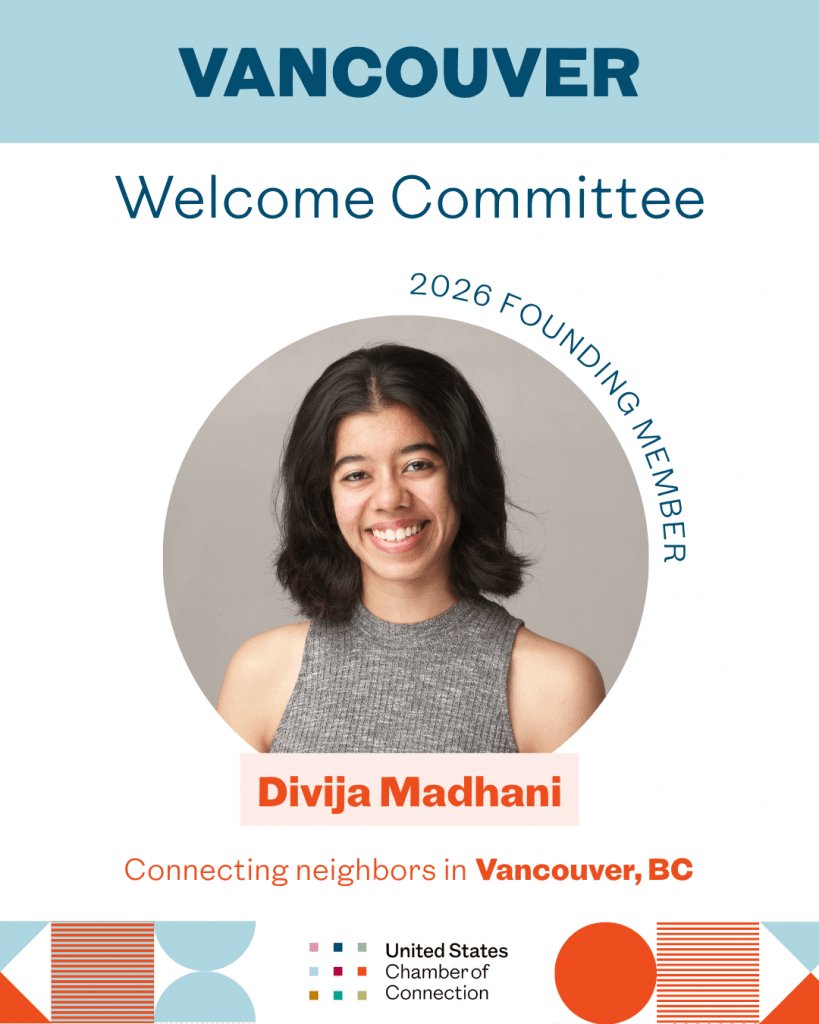
July 2026 | US Chamber of Connection: Divija Madhani is a Founding Member of the Welcome Committee
The Welcome Committee is a national movement to reconnect neighbourhoods, one conversation at a time. I joined because I believe caring is revolutionary, especially when shared, organized, and practiced. I want to cultivate this relational ethic of care at the neighbourhood level to realize hyperlocal solutions to the metacrisis and reimagined futures for regenerative flourishing.
Over the next few months, I’ll be having one-on-one conversations with my neighbours and planning a social gathering to co-create a sense of neighbourhood belonging in a way that is relational and playful.
July 2026 | Artefacts of Care: POP Praxis at the Marine Gateway Summer Art Market on July 11th and 18th from 12 PM to 5 PM
What does practicing community connection and care involve?
Hint: Lots of art!
Stop by the POP Praxis booth at the fourth annual Marine Gateway Summer Art Market on Saturday, July 11th and 18th from 12 PM to 5 PM to enjoy one-of-a-kind handcrafted pieces designed to inspire adventure, social outreach, and thoughtful reflection.
Selection ranges from small and large art prints to colourful bath salts, textured bookmarks, mesmerizing origami mobiles, picturesque magnets, paper puzzles, punny stickers, and more!
Bonus experiences at the POP Praxis booth include bubble blowing and free snack giveaways for community patrons!
May 2026 | Community Conversations: Stewarding Intergenerational Dialogues as a Community Partner to UBC Sustainability Ambassadors ‘Relational Care’ Cohort
Supported by funding from the UBC Community-University Engagement Support (CUES) Fund, POP Praxis is stewarding a community connection and care initiative that brings together Marpole Oakridge Family Place and the UBC Sustainability Hub to build intergenerational youth–senior dialogues on climate, health, affordability, and civic participation to create five dialogue sessions, a community action plan, and open planning tools. Read about the project here.
April 2026 | Next-Door Table: Piloting Community Connection in Multi-Unit Residential Housing
Launched in April 2026, the Next-Door Table pilot program is a tangible experiment in belonging. Supported by microgrants from DIVERSEcity and Metachrysalis, this initiative brings neighbours together to share meals, stories, and resources. It’s a small-scale intervention with a big vision: proving that connection is the bedrock of resilience.
November 2025 | Nurturing Younger Adults’ Voices in Civic Life in the NSYC Forum 5.0
We are deeply honoured to facilitate the fifth cohort of the North Shore Youth Civic (NSYC) Forum, a spring-time journey bringing young adults into the heart of local politics. Since November 2025, we’ve moved from initial dialogue to structured deliberation, empowering participants to map power, understand governance, and co-create solutions for their communities.
In the media and speaking engagements
ON THE POWER OF CARE
✓ Upcoming | Care Leadership: Contributing author to the upcoming book, Change-makers: Feminist Scholar-Activism for Gender Justice.
✓ April 2026 | Sustainability Changemakers: Alumni Celebration Panelist.
✓ August 2025 | Sustainability Ambassador Alumni Interview: Featured in the UBC Sustainability Ambassador Alumnus Profile, discussing how to embed care into urban planning and policy. Read the interview here.
Partner spotlight
THE CHANGE ECOSYSTEM
We are grateful to the organizations and individuals who trust us to co-build with them. Recent collaborations include:
❤︎ Project Arrowroot: Mentoring the Spring 2026 Youth Activator Cohort.
❤︎ Tanah Air Project: Facilitating a workshop at the Newcomers Climate Camp on Mental Health and Climate Resilience.
❤︎ Academy for Sustainable Innovation and The Starfish: Participating in the 2025 Youth Environmental Leaders Learning Lab (YELL Lab) to explore climate action and environmentalism leadership, skills, and networks.